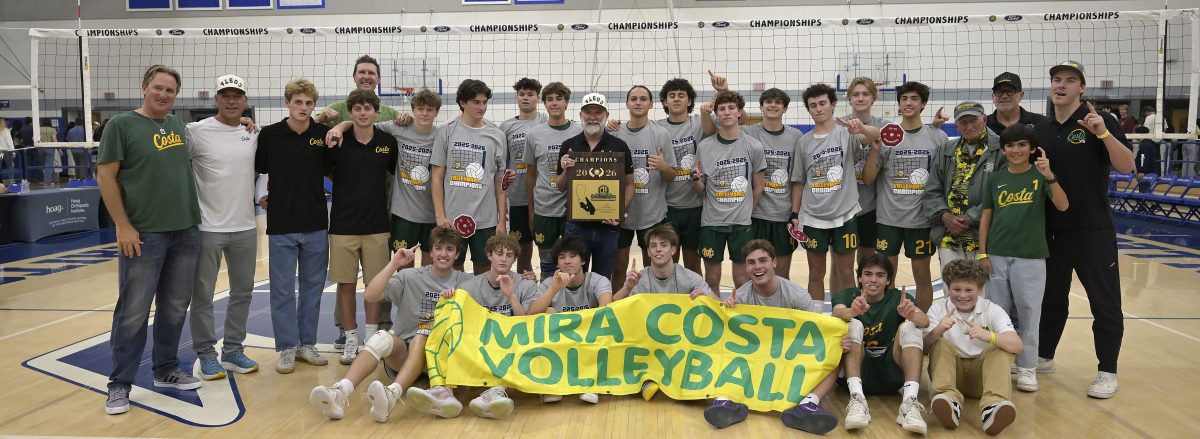
Last year’s Mira Costa High School Boys Volleyball squad was a hard act to follow. Not only was that Mustang team regional, state and national champions, but six players went on to Division I college volleyball careers.
Those feats and players cast a large shadow, daunting not only due to what was achieved, but the void they left behind. How do you replace six legendary players?
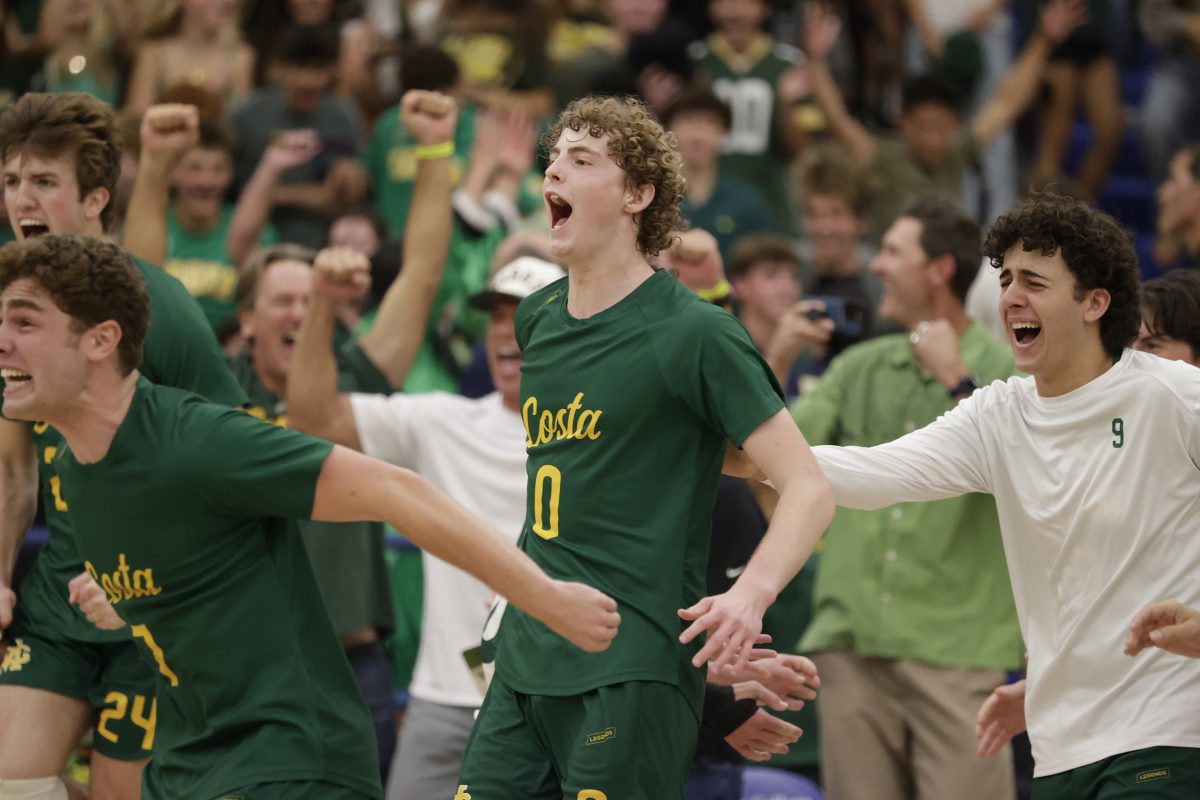
The answer, it turns out, is twofold. Grit, and the rise of Mateo Fuerbringer. Both of those factors were in evidence during a three set sweep of archrival Loyola last Friday as the Mustangs claimed the CIF Southern Section championship.
Fuerbringer, a 6-foot-4 outside hitter, began the match in dominating fashion, ending Loyola’s first three rallies with booming kills, and finishing the first set with his 12th kill. The Mustangs came back from a 17-11 deficit in the third set and took match point on a final emphatic kill by Fuerbringer. In between those first and last points, the ferocious grind of this Mustang squad was on full display, with bodies flying around the court and a stifling defense — led by senior Wyatt Davis’s astonishing nine blocks — confounding a powerful Loyola offense.
Coach Greg Snyder, who is in his third year at the helm of Costa volleyball, said what this year’s team lost in terms of sheer star power it has more than made up for with effort. Costa also has arguably the fastest rising star in the nation in Fuerbringer, who showed flashes last year as a sophomore but this year became one of the best players in the nation. He had a stunning 27 kills against Loyola despite the match only lasting three sets.
“Mateo has definitely elevated his game this season to a level that to me I haven’t seen since I’ve been in high school volleyball,” Snyder said. “And then everyone else is buying in. This is just one of the scrappiest groups that we’ve had at Costa. So it’s just a great combination. Usually, we rely mostly on talent. I don’t think Costa is known as being a gritty or scrappy bunch, but this year we definitely are.”

The scrap, Snyder said, comes mostly from a group of seniors who don’t have the recruiting headlines of their predecessors and who have used that as fuel all season. Senior libero Dane Del Riego, for example, had 15 digs in the Loyola match.
“I personally think it’s more the seniors that are overlooked, guys like Colby [Graham] and Enzo [Barker], guys like Jake Newman, guys that aren’t going anywhere [to play DI college ball],” Snyder said. “They want to show people that they’re good volleyball players too. All those guys have a grit and grind to them that is really unmatched. So that’s where I think it’s coming from, for the most part — but a lot of our players have it, our juniors, as well. Everyone’s fighting for spots and taking their chances when they get opportunities. So it’s creating just a really tough practice environment for everybody in a good way.”
That environment, Snyder said, reflects something he recognizes from his own playing days. Snyder was a two-sport All-League athlete at Costa in the early 1990s, played for legendary Mustang coach Mike Cook, and went on to play Division I soccer at LMU.
“To me this is the closest team to, I guess, my mindset and how I used to play,” he said. “So to me it feels good that these guys are grinding as hard as I feel I used to.”
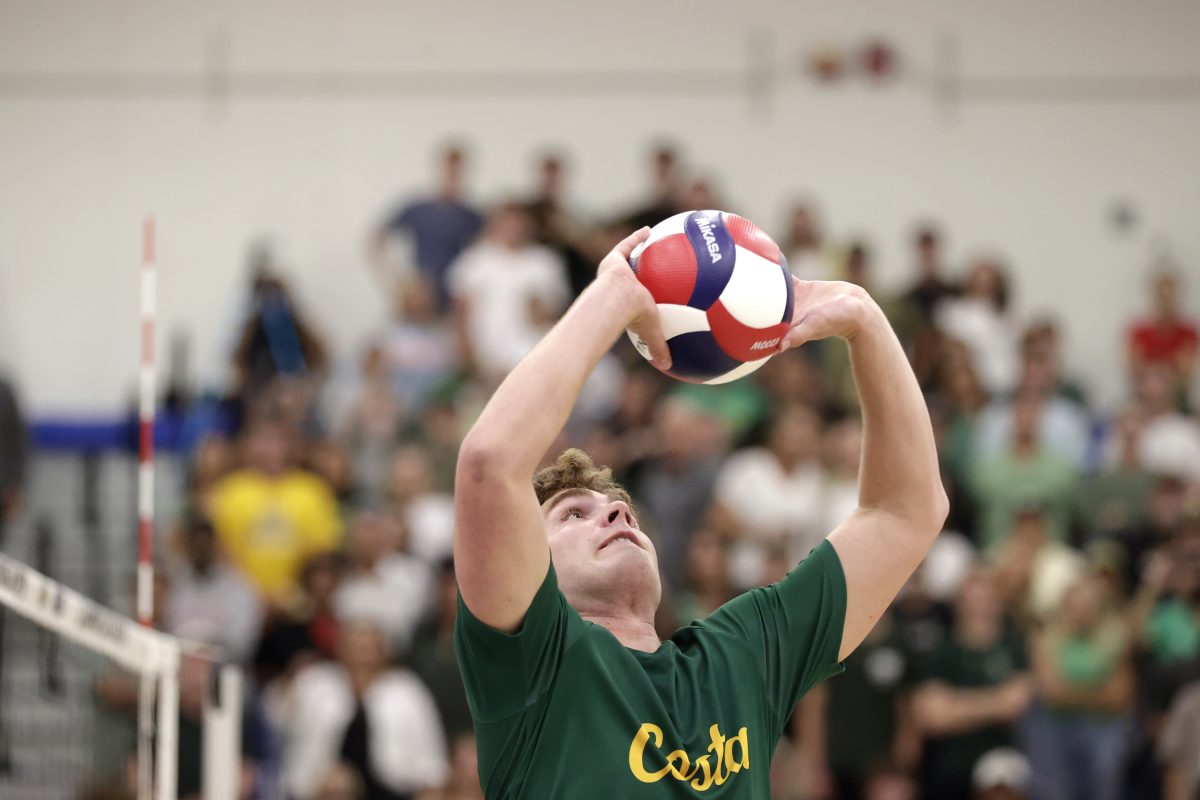
If the seniors are the engine of the grit, the player who orchestrates the whole machine is Newman, a transfer who arrived this season and stepped into the setter role vacated by Andrew Chapin, the USC-bound senior who quarterbacked last year’s championship squad.
“Jake brings just like a steadiness to him,” Snyder said. “The team kind of rallies around him. When he’s checked and engaged and firing on all cylinders, I feel like the team follows. We have other guys who have fire and bring different sorts of leadership, but the team just seems to rally around Jake. And he’s doing a great job leading this team and making sure we’re on the right page.”
Then there is Fuerbringer, who is committed to UCLA, the top-ranked program in the nation. As a freshman and sophomore, he played alongside a roster so deep with talent — including Cooper Keane, the top-ranked outside hitter in the country, and Grayson Bradford, the 6-foot-11 outside hitter now at UCLA — that he rarely got prime sets. He produced anyway. This year, with the offense running through him, his numbers have exploded.
“He’s always had [the clutch gene],” Snyder said. “Just the last two seasons, like he wasn’t the first option, so he’d usually get bad sets the majority of the time, or like the bailout balls. That’s what he had to work with the last two seasons…Now this year he’s getting everything and handling it like someone so much older and wiser and more mature. He’s still a junior.”
What is new this year is Fuerbringer’s physicality. Snyder said the IQ and the composure were always there. The strength was not.
“This year he has gotten a lot more physical,” Snyder said. “He’s able to hit over blocks, which I don’t think he was really quite there last year. He’s just got so much more strength behind his arm. You combine his power with the IQ he’s always had, and he has an answer for anything you throw at him. And there are no answers for him. He can do everything. No matter what — you put three blockers up, he’ll still find a way to get a kill. He pretty much doubles everybody up in terms of kills every single match. I’ve ever seen something like that.”
Davis, the senior middle blocker headed to UC Santa Barbara next year, has been the other defining presence on the floor. If Fuerbringer is the star, Davis is the unmatched hunger of this team made visible.
“It seems like he wants this title more than anybody, and it translates,” Snyder said. “You see his drive, you see his hunger, you see what he wants for the team. I think that helps, with his leadership, to drive the younger players. He had nine blocks in the three set final, which is a crazy number of blocks in such a short match.”
The third set of that final was the match’s defining stretch. Mira Costa fell behind 17-11 and looked, briefly, like a team that might let a sweep slip away. Snyder said the comeback was less a single moment than a deliberate recalibration.
“Our guys never stop fighting, no matter the score. We have a lot of ways we can score points, and they know that,” he said. “At 17-11 we had a couple ideas in terms of serving strategy. The one that we were dealing with at that point wasn’t working, so we went back to our original one. And we told the guys they had to be aggressors. All the breaks you need [to win] were going Loyola’s way in that third set. I told them that they’re getting breaks because they’re the aggressors right now, so we need to find a way to get back to being the aggressive team. And that’s what they did, starting getting after it a little bit more, not back on our heels. And we found ways to catch up.”
If grit and Fuerbringer are the two halves of the on-court answer to last year’s departures, the off-court answer is the coaching staff. It is an unusual brain trust for a high school program. Snyder has tapped into the deep reserves of Costa’s own volleyball history and brought back some of its most accomplished alumni to coach the next generation.
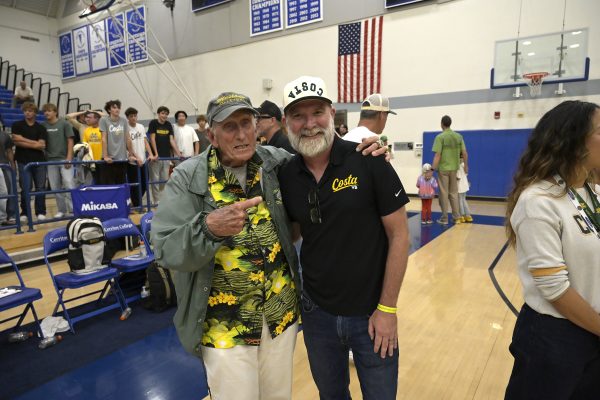
Cook, the program’s patriarch, returned to the bench as a varsity assistant. In 29 years as Costa’s head coach he won 27 league championships, eight CIF titles, and posted a varsity record of 627-93. Canyon Ceman, another assistant, led the 1990 Mira Costa team to a CIF championship and an undefeated national title. He was the NCAA National Player of the Year at Stanford, and went on to a 15-year professional beach volleyball career that included a runner-up finish at the 1997 FIVB World Championships. Olympic gold medalist Eric Fonoimoana, who won beach volleyball gold at the 2000 Sydney Games, also lends time to the program. Nick Scheftic, a former UCLA national champion and Pan American Games gold medalist with Team USA, is on the varsity staff. Ben Coate, a former Mira Costa CIF MVP who went on to play at UC Santa Barbara, is Snyder’s full-time assistant.
Most of those coaches are part-time, fitting Costa around their own careers and lives. Snyder said that has not diluted the contribution.
“My coaching staff is absolutely incredible,” he said. “If you look at who’s on our bench as far as coaches, that’s a huge long resume that most teams don’t have. Every single one of them adds something vital to the program. That’s always been my thing. How do you make your team better when you have people like that who want to help? Why would you not take it? “

The variety of voices, Snyder said, has been a quiet competitive advantage all season.
“Everyone gets information differently and responds differently to different coaches,” he said. “So the fact that we have so many different ways to get that information to these kids, I think there’s ways for everyone to obtain that information and implement it. Which is another reason why we’re where we are right now.”
Snyder said the work is not done.
“Definitely a good finish in the Southern Section,” he said. “Hopefully we do the same for regionals and the state.”
The Mustangs began their state tournament run on Tuesday, defending the CIF Division I state championship against the team they beat last spring, No. 8, 25-17, 25-11, 25-16. ER