by Laura Garber
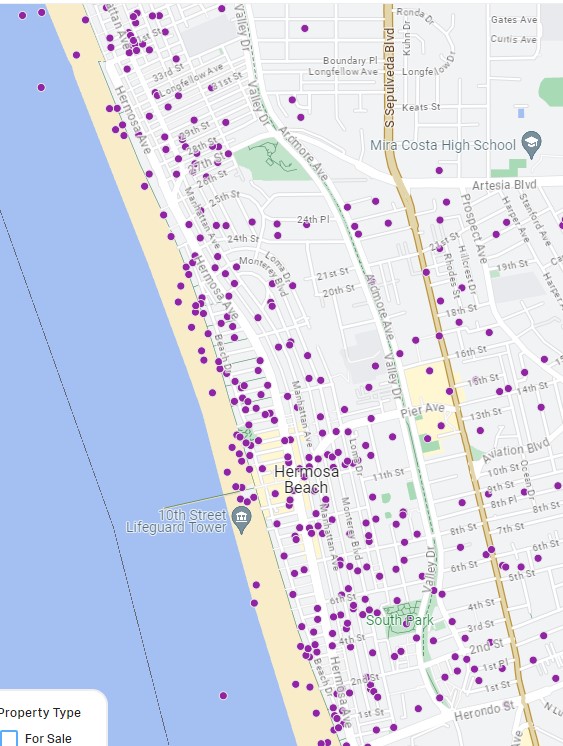
An estimated 180 to 250 Hermosa Beach property owners who operated unlicensed short term vacation rentals (STVRs) will be required to pay the city’s 14 percent Transient Occupancy Tax, going back four years, the city announced in a press release last week.
The city’s estimated total for the unpaid STVR taxes is $5 million, or approximately $20,000 to $70,000 per property owner.
Property owners will be required to pay the back taxes before being issued an STVR business license, according to the press release.
In 2016 Hermosa passed an ordinance prohibiting STVRs (rentals under 30 days), except for nonconforming residences in commercial zones. But last March, a court ruled the ban is illegal in the coastal zone (west of Valley/Ardmore.)
As a result of the ruling, last week the city began licensing short term vacation rentals in the coastal zone. They remain illegal in other residential neighborhoods.
“Due to a recent legal decision, short-term vacation rentals (STVRs) are now permitted in Hermosa Beach’s coastal zone and in commercial zones established under the City’s 2019 pilot program,” the June 4 press release stated. “As a result, all STVR operators in the City are now required to register their properties, obtain a City business license and pay any Transient Occupancy Tax (TOT) incurred since May 2022.”
Councilmember Ray Jackson said he was notified by concerned residents of the City’s press release and was unhappy with the word “permitted,” used in the letter. He said it implies “open-season” on STVRs despite the unchanged city ordinance.
“The City’s focus should be on collecting unpaid TOT from illegally operated STVRs,” Jackson said in an interview. “As a community, we’ll determine what a future long-term STVR program is going to look like. We have to be smart in how we do this. It has to be thought out, you can’t be reactive.”
Administrative Services Director Brandon Walker said the $5 million estimate was a arrived at two ways: by applying the state’s four-year lookback window under California’s revenue and taxation code, and through data gathered by Deckard Technologies, a GovTech platform that scrapes public booking sites like Airbnb and VRBO to document rental activity.
Walker cautioned that the figure is a rough estimate, noting that the top 25 to 30 properties, mainly along The Strand, account for a disproportionate share of potential revenue, while smaller units represent far less.
“This is a direct reaction to losing that lawsuit,” Walker said. “There’s still a full Coastal Commission process the city will potentially go through when it comes to what medium and long-term restrictions could look like. There will be opportunity for the public and council to weigh in on what they want to see our STVR program to look like long term.”
The City is using the same Deckard platform to register new STVRs and to collect back TOT revenue.
“STVR operators who register their properties and pay all retroactive TOT amounts by August 1, 2026 will have all retroactive interest and penalties waived,” the press release stated. “Those who pay after the deadline may be subject to interest penalties and fines.”
Property owners who dispute their lookback amount may request a formal administrative hearing.
“I would not be surprised if people do go down that route,” Walker said. “I think the look back period is quite unique.”
The City is exploring how to collect delinquent TOTs.
“Options include liens, etc,” Walker said. “But there really is no one size fits all approach.”
Hermosa may face a legal obstacle in collecting the estimated $5 million in TOT revenue from previously unlicensed STVRs, attorney Frank Angel said this week.
Angel was the plaintiffs’ attorney in both the Hermosa and Manhattan Beach cases in which the judge ruled the cities’ STVR bans in the coastal zone are unenforceable.
Angel noted that Hermosa’s TOT ordinance applies only to “permitted” STVRs. As a result, past TOT taxes cannot legally be collected from unlicensed, or unpermitted STVRs, Angel contended.
In May, the council addressed this issue by striking from the TOT ordinance, the word “permitted” in front of the phrase “short term vacation rentals.”
But the council lacks the authority to delete “permitted,” Angel contends, because the ordinance, Measure H, was approved by voters on the November 2015 ballot. Initiative measures can only be changed by the voters,” he said.
At the Tuesday, June 9 City Council meeting, Councilmember Michael Keegan raised questions regarding the illegal STVRs during council comments.
“I think what we should probably do is do nothing for a little bit, and see how we do on collecting the previous monies,” Keegan said, citing Manhattan Beach’s hands off approach after losing the right to enforce its ban on STVRs. “I do not think we should follow the lead of creating a bureaucracy to end those revenues, because we’re going to collect $4 million in back taxes, and we’ll soon be collecting almost $1.5 to $2 million in new TOT revenue. We should digest those before we do anything.”
Jim Holtz, an STVR operator, who has spoken at various city council meetings on the matter, attended the June 9 meeting after hearing about the city’s TOT and STVR press release.
Over the years, he has set aside TOT for the city in an escrow account, and said he is prepared to pay. But he expressed concern about Deckard Technologies’ protocol.
“I’m already collecting TOT, and I really want to pay it. It’s just sitting there in my escrow account, and I’d rather have the city have it,” Holtz said. “But the portal is asking for questions that have nothing to do with paying TOT.”
Holtz claimed the portal asked him to sign agreements, such as maximum occupancy under perjury.
“[This] has nothing to do with me paying TOT,” he said.
Holtz asked council to allow STVR operators to pay the TOT directly to the City.
Yvonne Bernard, a film producer and STVR operator on The Strand, has been renting out her home “for a while,” she said.
Bernard said she began renting her home to help pay her mortgage as film industry work declined.
“I only have families. We haven’t had any parties. I think that we absolutely do our best, not to bother our neighbors. It’s not our intention,” she said. “The reason is to be able to find a good way to support our homes if our jobs are not doing it.”
Bernard said she spent years trying to work with the City and advocacy groups to allow STVRs in Hermosa Beach, including offering to pay the TOT.
“Now they want it, just because they’re forced into allowing vacation rentals,” she said of the retroactive TOT plan. “It just is not right. I probably won’t pay it.”
Bernard hired attorney Patrick Carey to pay the fines imposed by the City — $5,000 for first-time violations — and to drop misdemeanor charges for advertising her home online.
To those who oppose STVRs in Hermosa, her stance is clear.
“It’s not your house. I should be able to do what I want. I pay my taxes. I pay for everything I’m supposed to do in Hermosa,” she said. “Just let it go and start charging taxes, a fair tax now. Why does the council have to make everything so hard?”
An STVR operator renting legally in Hermosa’s commercial district, who asked to remain anonymous, said he welcomed straightforward regulations that all could abide by.
“Many STVR’s in residential areas defied the ban, ran their short term rental business and didn’t pay TOT,” the STVR operator said. “This hurt those of us with legal STVRs in the commercial district because our costs were 14% higher for the same product because we were required to collect TOT on behalf of the City. By having the City create a process by which to legalize their STVR’s in residential areas, and collect TOT, it puts all operators on a more equal footing with regards to pricing.”
However, he is sympathetic to residents concerned about allowing STVRs outside of the commercial district.
“I think that allowing STVRs in the commercial district is good for everyone, but I can see how having them in the residential areas can affect property values and property tax revenue. I don’t think it is good in every circumstance.” he said. “There are large parts of Newport that have lost their residential character because of the STVR business.”
Mayor Mike Detoy said the Coastal Commission’s position requires the City to allow STVRs, but that the community’s quality of life remains a priority.
“Coastal Commission says we need STVRs. But the Hermosa Beach lifestyle, schools and small businesses are why we love it here. It’s not because there are STVRs on every corner,” Detoy said. “We need to protect our residents as much as coastal accessibility.” ER