by Laura Garber
“Doing nothing is no longer an option.”
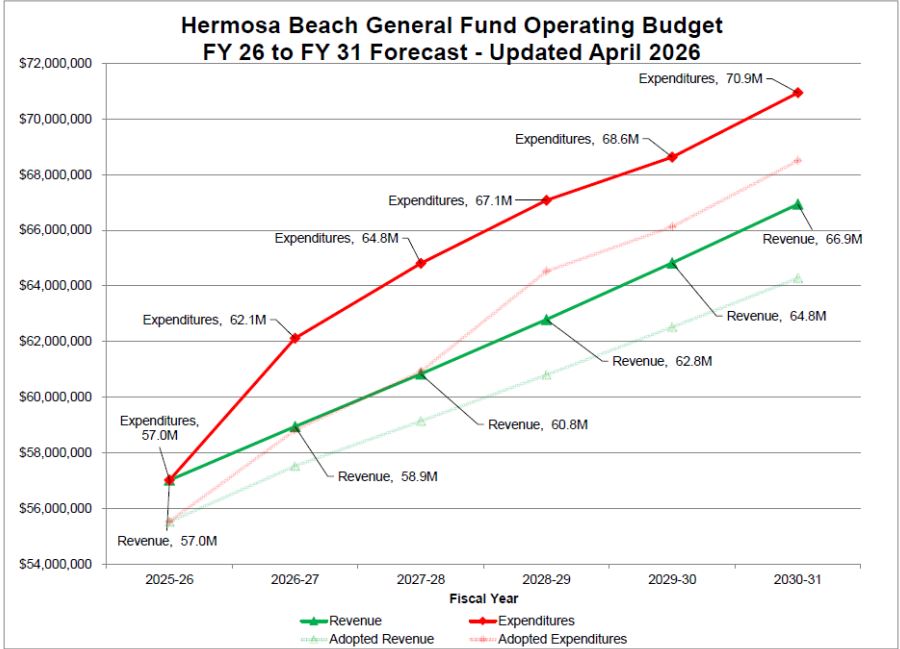
That was Hermosa Beach’s City Manager Steve Napolitano’s message to Council Tuesday, April 26 during the first of seven scheduled budget sessions centered on a looming $3.2 million 2027 deficit.
“The city’s current fiscal path is unsustainable,” Napolitano said. “Hard choices will be proposed to fill the gap through a combination of spending cuts and revenue enhancements.”
Administrative Services Director Brandon Walker told the council recurring costs are growing four to six percent annually while revenues grow only two to four percent. The result is a projected five-year shortfall of $19.3 million. Which is nearly twice the city’s current general fund reserves of $10.6 million.
The city balanced its 2025-2026 budget using one-time funds, including federal pandemic relief, staff vacancy savings and deferred capital spending.
“Revenue was not keeping up with expenses over the past five years,” Walker said. “We were just lucky enough to have one-time windfalls every year to cover shortfalls.”
Major cost drivers include a 26 percent increase in the LA County fire contract, adding roughly $1.8 million over the next three years, labor costs rising three percent annually and police overtime estimated at $1.18 million for the 2025-2026 budget.
Hermosa currently pays $400,000 annually to Los Angeles County for lifeguard and beach maintenance services. The payments are funded under a revenue sharing plan involving the downtown parking structure. The county has indicated it wants the city to pay the full cost of lifeguards and beach maintenance when the current contract expires. The cost is $4.9 million annually.
The city also needs to replace, or remove its pier. Estimates range from over $50 million.
The City Yard also needs replacement, at a projected cost of $20 million.
Staff told the council it could increase revenue by up to $1 million annually by legalizing Short Term Rentals in the commercial districts, and collecting the 14 percent Transient Occupancy Tax. A court recently ruled the city’s ban on Short Term Rentals in the coastal zone is illegal.
Staff also estimated the city could collect up to $5 million in retroactive short term rental fees.
Councilmember Saemann asked staff to draft short term vacation rental regulations modeled on other, comparable coastal cities.
The council also discussed a local sales tax measure generating roughly $1 million annually per quarter-cent increase, parking rate increases and “dynamic” parking pricing, generating $1.5 to $2 million
Staff was also directed to develop a 10 percent reduction strategy by the May 12 council meeting.
Council voted 5-0 to extend the budget delivery deadline to May 30. Final budget adoption is set for June 23. ER